Scale intervals. What do all these numbers mean
You man have heard people refer to things such as augmentented fourth or flat seventh, but what do these numbers mean?
These numbers refer to any note relative to the note or chord you are on or key that you are in.
Rather than saying ‘go up three frets’ or ‘go up one string and back two frets’, you may say ‘go up a minor third’
Before I get too in depth, because of how these theories evolved there are many names for the same intervals, see the table at the root of the page for more.
If you were in the key of E, then E would be the root.
So if you played the low E string, this would be root, if you then played an E on the same string by fretting the 12th fret, you would be playing an E 8 steps higher in a standard major scale, this in known as the octave of the root, oct in reference to 8
So you may notice there are still frets 1 to 11 without any name, yet we have only numbers 2 through 7 unused.

So let's look at the major scale in more detail:

Each note of the major scale can be known as:
- the first note is the root
- the second note is known as a major second, usually referred to as the second
- the third note is a major third, usually referred to as a third
- the fourth note is a perfect fourth, again usually called a fourth
- the fifth note is a perfect fifth or a fifth
- the sixth note is a major sixth
- the seventh note is a major seventh
- and finally the octave or perfect unison note
We'll take a look at the minor scale next:
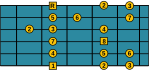
Looking at this scale some notes are the same, in this scale we have:
- the first note is the root
- the second note is known as is a major second, the same as above
- the third note is a minor third, this is a semitone or one fret lower than a major third
- the fourth note is a perfect fourth
- the fifth note is a perfect fifth
- the sixth note is a minor sixth, this is a semitone or one fret lower than a major sixth
- the seventh note is a minor seventh, this is a semitone or one fret lower than a major seventh
- and finally the octave or perfect unison note
So how do you refer to any notes regardless of scale?
Slide the scale below to change the key and see what each note is referred to as
| Interval name | Example of note | Short name | Other names |
|---|---|---|---|
| Root | E | R | |
| Minor second | F | m2 | Flat 2 |
| Major second | F♯ | M2 | |
| Minor third | G | m3 | Flat 3 |
| Major third | G♯ | M3 | |
| Perfect fourth | A | P4 | |
| Flat fifth | A♯ | ♭5 | Sharp 4 |
| Perfect fifth | B | P4 | |
| Minor sixth | C | m6 | Flat 6 |
| Major sixth | C♯ | M6 | |
| Minor seventh | D | m7 | Flat 7 |
| Major seventh | D♯ | M7△7 | |
| Octave | E | Perfect unison |
You may have seen numbers higher than 8, these simply refer to the same note, but played an octave higher, a ninth is a second, but at octave higher, these values have different meanings when referring to chord names
Knowing the names of these will help you be able to work out chord names