The seven modes of the major scale
Ionian, Dorian, Phrygian, Lydian, Mixolydian, Aeolian and Locrian. Summary
Ionian
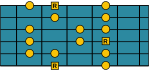
If you know the major scale, then you can create six more scales or modes from this scale.
If you don't know the major scale, then the key of C is a good place to start. The C major scale is easy to remember as it contains no sharp or flat notes, it is in fact all the white keys on a piano keyboard. C D E F G A B C, the intervals between these notes are as follows (where T = tone or two frets, S = semitone or one fret): T T S T T T S. The major scale is also known as the Ionian mode (R,M2,M3,P4,P5,M6,M7,8ve).
The feeling created with the ionian is happy, think nursery rhymes
A major scale (A, B, C♯, D, E, F♯, G♯, A)
Dorian

Now say we start from the second note in this scale, the D. We now have D E F G A B C or T S T T T S T. This mode has a melancholy sound to it, jazz and minor blues vibes. This mode is know as the Dorian mode. It is like the natural minor scale with a major 6 (R,M2,m3,P4,P5,M6,m7,8ve)
A dorian mode (A, B, C, D, E, F♯, G, A)
Phrygian

The next mode is the Phrygian mode, E F G A B C D E or S T T T S T T, this mode has a Spanish feeling, played over Am, G, F and E this gives you an instant flamenco sound. This is like the minor scale with a flat 2 (R,m2,m3,P4,P5,m6,m7,8ve)
A phrygian mode (A, B♭, C, D, E, F, G, A)
Lydian

The fourth mode is the Lydian mode, F G A B C D E F or T T T S T T S, this mode has a funky sound, think of the Simpsons or Grange Hill TV themes these both use the lydian mode. It is like the major scale with a sharp 4 also known as a flat 5 in some scales, which gives it that bluesy element (R,M2,M3,A4,P5,M6,M7,8ve)
A lydian mode (A, B, C♯, D♯, E, F♯, G♯, A)
Mixolydian
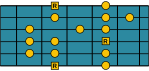
The fifth mode is the Mixolydian mode, G A B C D E F G or T T S T T S T, this mode works very well over dominant seven chords, which the blues often uses, a really good way to get more interesting bluesy sounds than using the minor pentatonic or blues scale. I will cover those last two scales in another lesson, I would recommend learning these before learning these modes. This is like the major scale with a minor 7 (R,M2,M3,P4,P5,M6,m7,8ve)
A mixolydian mode (A, B, C♯, D, E, F♯, G, A)
Aeolian

The sixth mode is the Aeolian mode, A B C D E F G A or T S T T S T T, you may recognise this as the natural minor scale, as it is also known as this. You may have heard that A minor is the relative minor to C major. This mode has a sad quality to it. (R,M2,m3,P4,P5,m6,m7,8ve)
A minor scale (A, B, C, D, E, F, G, A)
Locrian

The seventh mode is the Locrian mode, B C D E F G A B or S T T S T T T, this is a dark mysterious mode. This is like the minor scale but with or flat 2 and a flat 5 or think of it like the phrygian mode with a flat 5 (R,m2,m3,P4,♭5,m6,m7,8ve)
A locrian scale (A, B♭, C, D, E♭, F, G, A)
I would recommend learning each mode in it's own right, rather than trying to work each mode out on-the-fly from one scale, although this may help get you out of a fix occasionally.
Learn each mode in every key and position. On a guitar you can learn a scale in one key and then just slide it up or down a required number of frets to transpose to another key, while this is strictly true, it is good to be able just think in any key as it's amazing how you can come unstuck when you are suddenly asked to play in B flat or any key which isn't in guitar friendly A or E.
Listen to each mode as you play it, hear how each one has it's own flavour or character. When you are trying to convey a certain feeling, you may think of a certain mode. In reality you should know these modes inside out so that you don't have to make a conscious decision, more play from instinct. One way to think about it is to learn all your scales and then forget them, as crazy as that sounds.
The method I came up with when learning the modes and their names was:
- I – Ionian
- Don't – Dorian
- Phone – Phrygian
- Like – Lydian (Li helped me remember Ly)
- My – Mixolydian
- Alien – Aeolin
- Lords – Locrian (Lo helped me remember Lo)
Come up with your own method or use mine, I found by making up my own I was less likely to forget it.
Have a look at the backing tracks page, for Seven Modes, this track plays a backing for four bars for each mode in order, in the key of E.